Office Applications and Entertainment, Magic Squares | ||

 |
Index | About the Author |
|
17.0 Special Magic Squares, Big Primes
Certain Prime Number Magic Squares can only be constructed based on very large prime numbers, further referred to as Big Primes.
17.2 Magic Squares (3 x 3)
A well known example is the 3 x 3 Prime Number Magic Square of consecutive prime numbers, with magic sum s1 = 4440084513, as published by Harry Nelson (ref. Journal of Recreational Mathematics, 1988, pages 214-216):
A very impressive result for those days, although these days the result can be easily found by scrolling through databases as available from the internet.
Or shorter:
17.2.2 Non Consecutive Prime Numbers
As an illustration of the method described in Section 17.2.1 above, Order 3 Simple Magic Squares of non consecutive prime numbers
have been generated for the range {1480020013 ... 1480029919}.
The elements of two suitable selected Order 3 Latin Squares A1 and B1,
result in an Order 3 Prime Number Magic Square C with elements
ci = ai + bi,
i = 1 ... 9.
|
A1, MC = 537645
179230 179200 179215 179200 179215 179230 179215 179230 179200 B1, MC = 20511
6837 7443 6231 6231 6837 7443 7443 6231 6837 C = A1 * 104 + B1, MC = 5376470511
1792306837 1792007443 1792156231 1792006231 1792156837 1792307443 1792157443 1792306231 1792006837
|
The Magic Series {ai, i = 1 ... 3} and {bj, j = 1 ... 3}
are selected from the first resp. the second part of the Broken Primes such that
cij = ai * 104 + bj (i,j = 1 ... 3) are distinct prime numbers (9 ea).
17.3 Magic Squares (4 x 4)
Even more impressive are the 4 x 4 Prime Number Pan Magic Squares of consecutive prime numbers as published by:
and M. Alekseyev (2014) with magic sum s1 = 682775764735680
The square shown above is, according to M. Alekseyev, the minimum solution
e.g. has the minimum magic sum for 4 x 4 Prime Number Pan Magic Squares of consecutive prime numbers.
17.3.2 Non Consecutive Prime Numbers
As an illustration of the method described in Section 17.2.1 above, Order 4 Pan Magic Squares of non consecutive prime numbers
have been generated for the range {1480020013 ... 1480029919}.
The elements of two suitable selected Latin Squares A1 and B1, with latin main diagonals,
result in a Prime Number Magic Square C with elements
ci = ai + bi,
i = 1 ... 16 (ref. Attachment 14.8.1a).
|
A1, MC = 717521
179363 179369 179390 179399 179390 179399 179363 179369 179399 179390 179369 179363 179369 179363 179399 179390 B1, MC = 2320
257 461 699 903 903 699 461 257 461 257 903 699 699 903 257 461 C = A1 * 103 + B1, MC = 717523320
179363257 179369461 179390699 179399903 179390903 179399699 179363461 179369257 179399461 179390257 179369903 179363699 179369699 179363903 179399257 179390461
|
The Magic Series {ai, i = 1 ... 4} and {bj, j = 1 ... 4}
are selected from the first resp. the second part of the Broken Primes such that
cij = ai * 103 + bj (i,j = 1 ... 4) are distinct prime numbers (16 ea).
17.3.4 Balanced Series
The construction of Prime Number Pan Magic Squares based on Latin Squares, requires Balanced Magic Series as defined in
Attachment 14.8.1b.
|
A1, MC = 773750
190745 196130 192824 194051 192824 194051 190745 196130 194051 192824 196130 190745 196130 190745 194051 192824 B1, MC = 2320
257 461 699 903 903 699 461 257 461 257 903 699 699 903 257 461 C = A1 * 103 + B1, MC = 773752320
190745257 196130461 192824699 194051903 192824903 194051699 190745461 196130257 194051461 192824257 196130903 190745699 196130699 190745903 194051257 192824461
|
Attachment 17.3.4 shows a few examples of balanced series, selected from a wider range with an automatic filter.
17.3.5 Balanced Series
Prime Number Associated Magic Squares can be constructed based on Semi-Latin Squares and Balanced Magic Series.
|
A1, MC = 773750
190745 196130 196130 190745 192824 194051 194051 192824 194051 192824 192824 194051 196130 190745 190745 196130 B1, MC = 2320
257 461 699 903 903 699 461 257 903 699 461 257 257 461 699 903 C = A1 * 103 + B1, MC = 773752320
190745257 196130461 196130699 190745903 192824903 194051699 194051461 192824257 194051903 192824699 192824461 194051257 196130257 190745461 190745699 196130903
|
Attachment 17.3.4 shows a few examples of balanced series, selected from a wider range
with an automatic filter.
17.4 Magic Squares (5 x 5)
As an illustration of the method described in Section 17.2.1 above, Order 5 Associated Magic Squares of non consecutive prime numbers
have been generated for the range {1480020013 ... 1480029919}.
The elements of two suitable selected Latin Squares A1 and B1, with latin (pan) diagonals, result in a Prime Number Pan Magic Square C with elements
ci = ai + bi,
i = 1 ... 25 (ref. Attachment 14.8.1a).
|
A1, MC = 896505
179211 179217 179316 179355 179406 179355 179406 179211 179217 179316 179217 179316 179355 179406 179211 179406 179211 179217 179316 179355 179316 179355 179406 179211 179217 B1, MC = 2177
223 299 413 523 719 413 523 719 223 299 719 223 299 413 523 299 413 523 719 223 523 719 223 299 413 C = A1 * 103 + B1, MC = 896507177
179211223 179217299 179316413 179355523 179406719 179355413 179406523 179211719 179217223 179316299 179217719 179316223 179355299 179406413 179211523 179406299 179211413 179217523 179316719 179355223 179316523 179355719 179406223 179211299 179217413
|
The Magic Series {ai, i = 1 ... 5} and {bj, j = 1 ... 5}
are selected from the first resp. the second part of the Broken Primes such that
cij = ai * 103 + bj (i,j = 1 ... 5) are distinct prime numbers (25 ea).
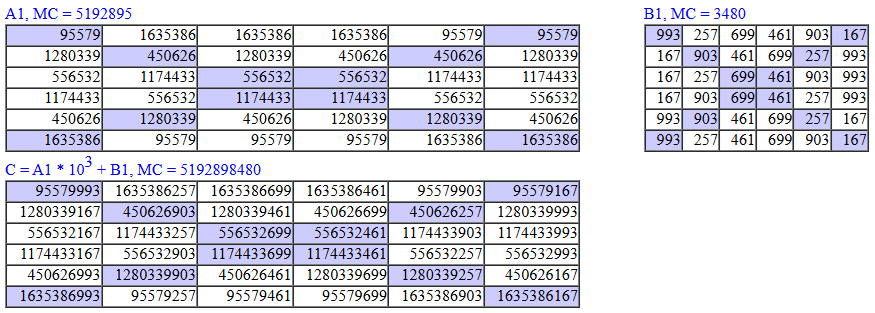
17.5 Magic Squares (6 x 6)
As an illustration of the method described in Section 17.2.1 above, Order 6 Simple Magic Squares of non consecutive prime numbers
have been generated for the range {1480020013 ... 1480029919}.
The elements of two suitable selected Semi Latin Squares A1 and B1,
with latin main diagonals,
result in a Prime Number Magic Square C with elements
ci = ai + bi,
i = 1 ... 36 (ref. Attachment 14.8.1b).
|
|
The Balanced Series {ai, i = 1 ... 6} and {bj, j = 1 ... 6}
are selected from the first resp. the second part of the Broken Primes such that
cij = ai * 103 + bj (i,j = 1 ... 6) are distinct prime numbers (36 ea).
17.6 Magic Squares (7 x 7)
As an illustration of the method described in Section 17.2.1 above, Order 7 Bordered Magic Squares of non consecutive prime numbers
have been generated for the range {1480020013 ... 1480029919}.
The elements of two suitable selected Latin Squares A1 and B1,
with latin (pan) diagonals, result in a Prime Number Pan Magic Square C with elements
ci = ai + bi,
i = 1 ... 49 (ref. Attachment 14.8.1a).
|
A1, MC = 720
0 303 6 9 87 126 189 126 189 0 303 6 9 87 9 87 126 189 0 303 6 303 6 9 87 126 189 0 189 0 303 6 9 87 126 87 126 189 0 303 6 9 6 9 87 126 189 0 303 B1, MC = 2215
11 421 257 547 491 337 151 547 491 337 151 11 421 257 151 11 421 257 547 491 337 257 547 491 337 151 11 421 337 151 11 421 257 547 491 421 257 547 491 337 151 11 491 337 151 11 421 257 547 C = A1 * 103 + B1, MC = 722215
11 303421 6257 9547 87491 126337 189151 126547 189491 337 303151 6011 9421 87257 9151 87011 126421 189257 547 303491 6337 303257 6547 9491 87337 126151 189011 421 189337 151 303011 6421 9257 87547 126491 87421 126257 189547 491 303337 6151 9011 6491 9337 87151 126011 189421 257 303547
|
The Magic Series {ai, i = 1 ... 7} and {bj, j = 1 ... 7}
are selected from the first resp. the second part of the Broken Primes such that
cij = ai * 103 + bj (i,j = 1 ... 7) are distinct prime numbers (49 ea).
Attachment 17.6.1 shows a few examples of such series, selected from the range {11 ... 391691} with an automatic filter.
17.7 Magic Squares (8 x 8)
As an illustration of the method described in Section 17.2.1 above, Order 8 Composed Magic Squares of non consecutive prime numbers
have been generated for the range {1480020013 ... 1480029919}.
The elements of two suitable selected Latin Squares A1 and B1,
with latin main diagonals, result in a Prime Number Magic Square C with elements
ci = ai + bi,
i = 1 ... 64 (ref. Attachment 14.8.1a).
|
A1, MC = 15653
0 21 182 1538 1755 1997 3617 6543 1755 1997 3617 6543 0 21 182 1538 1538 182 21 0 6543 3617 1997 1755 6543 3617 1997 1755 1538 182 21 0 3617 6543 1755 1997 182 1538 0 21 182 1538 0 21 3617 6543 1755 1997 1997 1755 6543 3617 21 0 1538 182 21 0 1538 182 1997 1755 6543 3617 B1, MC = 3502
59 101 179 503 587 599 701 773 179 503 59 101 701 773 587 599 587 599 701 773 59 101 179 503 701 773 587 599 179 503 59 101 599 587 773 701 101 59 503 179 773 701 599 587 503 179 101 59 101 59 503 179 599 587 773 701 503 179 101 59 773 701 599 587 C = A1 * 103 + B1, MC = 15656502
59 21101 182179 1538503 1755587 1997599 3617701 6543773 1755179 1997503 3617059 6543101 701 21773 182587 1538599 1538587 182599 21701 773 6543059 3617101 1997179 1755503 6543701 3617773 1997587 1755599 1538179 182503 21059 101 3617599 6543587 1755773 1997701 182101 1538059 503 21179 182773 1538701 599 21587 3617503 6543179 1755101 1997059 1997101 1755059 6543503 3617179 21599 587 1538773 182701 21503 179 1538101 182059 1997773 1755701 6543599 3617587
|
The Magic Series {ai, i = 1 ... 8} and {bj, j = 1 ... 8}
are selected from the first resp. the second part of the Broken Primes such that
cij = ai * 103 + bj (i,j = 1 ... 8) are distinct prime numbers (64 ea).
Attachment 17.7.2 shows a few examples of such series, selected from the range {59 ... 13965773} with an automatic filter.
17.8 Magic Squares (10 x 10)
As an illustration of the method described in Section 17.2.1 above, Order 10 Bordered Magic Squares of non consecutive prime numbers
have been generated for the range {1480020013 ... 1480029919}.
The obtained results regarding the miscellaneous types of Prime Number Magic Squares, as constructed and discussed in previous sections are summarized in following tables: |
Non Consecutive Prime Numbers
Order
Main Characteristics
Sub Routine
Results
3
Simple Magic Squares
4
Pan Magic Squares
5
Associated Magic Squares
6
Simple Magic Squares, Symm Dia's
7
Bordered Magic Squares
8
Composed Magic Squares
10
Bordered Magic Squares
Latin Square Based
Order
Main Characteristics
Magic Series
Results
3
Simple Magic Squares
4
Simple Magic Squares
Pan Magic Squares
Associated Magic Squares
5
Pan Magic Squares
7
Pan Magic Squares
8
Simple Magic Squares
|
This is the end of the Chapter 'Prime Number Magic Squares' of this website.
|
|
|
Index | About the Author |